2026-09-02 · Mike Sorensen
Furnace Sizing for Boise's Dry Air and 40-Degree Daily Swings
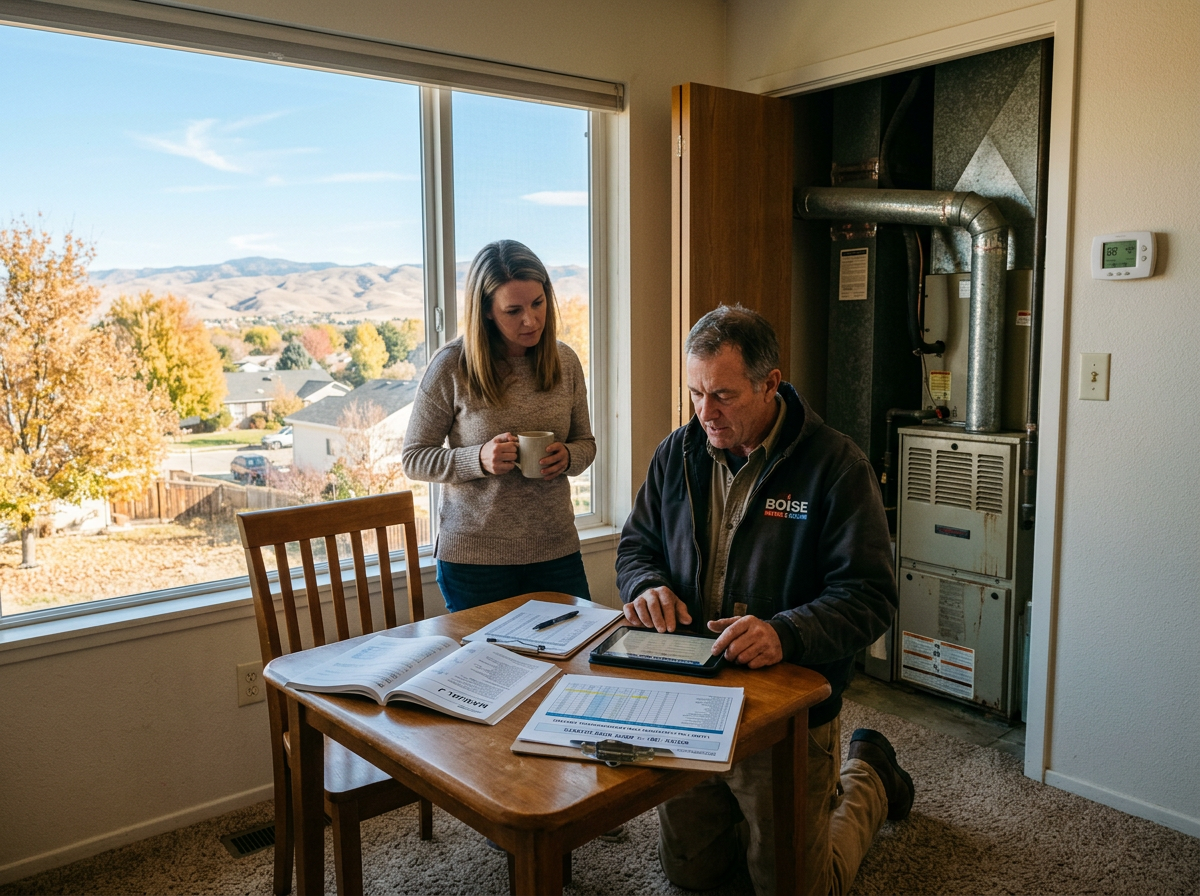
Furnace sizing for Boise starts with calculating capacity for the full 40-degree daily swing while keeping the unit large enough to run steadily through multi-day inversions without short-cycling in the dry 20-30% humidity air typical of shoulder seasons.
Accounting for Daily Temperature Swings
Boise often sees morning lows near 25°F and afternoon highs near 65°F in spring and fall. This forces a furnace to handle both the morning peak and the rapid afternoon drop-off. Oversizing by even 20% causes short cycles that waste fuel and wear the heat exchanger faster in dry air. Undersizing leaves the house cold during the morning spike. A proper load calculation therefore uses the design temperature at the coldest hour rather than a 24-hour average, then adds a small buffer only for the documented swing range. Homeowners in 2000s Meridian tract homes with original 80% furnaces commonly discover their units were sized for average conditions and now struggle on the coldest mornings.
Sustained Load During Winter Inversions
Treasure Valley inversions trap cold air for three to five days, keeping furnaces at constant output instead of normal cycling. This changes the sizing math because the equipment must maintain 70°F indoors while outdoor temperatures stay below 30°F without relief. In these stretches the dry air also lowers indoor relative humidity to 15-20%, so homeowners often raise the thermostat two degrees for comfort, increasing the required output. Proper sizing therefore includes a continuous-run factor rather than the standard 70-80% duty cycle used in milder climates. Many North End bungalows with retrofitted ducting need an extra 10-15% capacity to offset the added restriction and still meet this sustained demand.
Filtration Adjustments for Wildfire Smoke Seasons
Wildfire smoke raises the importance of MERV-13 or higher filters, yet denser filtration increases static pressure and reduces delivered BTU. When sizing a new furnace, the calculation must include the pressure drop from the upgraded filter so the blower can still move the required air volume. During heavy smoke years, filter changes every four weeks instead of the usual eight become necessary to keep airflow at design levels. Linking this to ongoing maintenance helps avoid the common mistake of upsizing the furnace to compensate for a clogged filter. See the details in Wildfire Smoke and Your HVAC: What Boise Homeowners Should Change.
Matching Equipment to Local Home Types and Fuel
Builder-grade 80% furnaces in 2000s Kuna and Star homes typically reach replacement age after 15-20 years. When replacing, the new unit should be sized to the actual measured heat loss rather than the original nameplate. Propane systems on rural properties outside Star often require slightly larger inputs because of longer duct runs and colder ground temperatures. In these cases a two-stage furnace sized at the calculated load prevents the short-cycling that single-stage units experience during shoulder-season swings. Review options in What Furnace Installation Costs in Boise and What Moves the Price and When to Repair and When to Replace a Furnace in the Treasure Valley.
Practical Takeaway
Measure the actual temperature swing over several shoulder-season days, note how long your current furnace runs during the next inversion, and bring those numbers to any sizing discussion so the new equipment matches Boise conditions rather than generic charts.