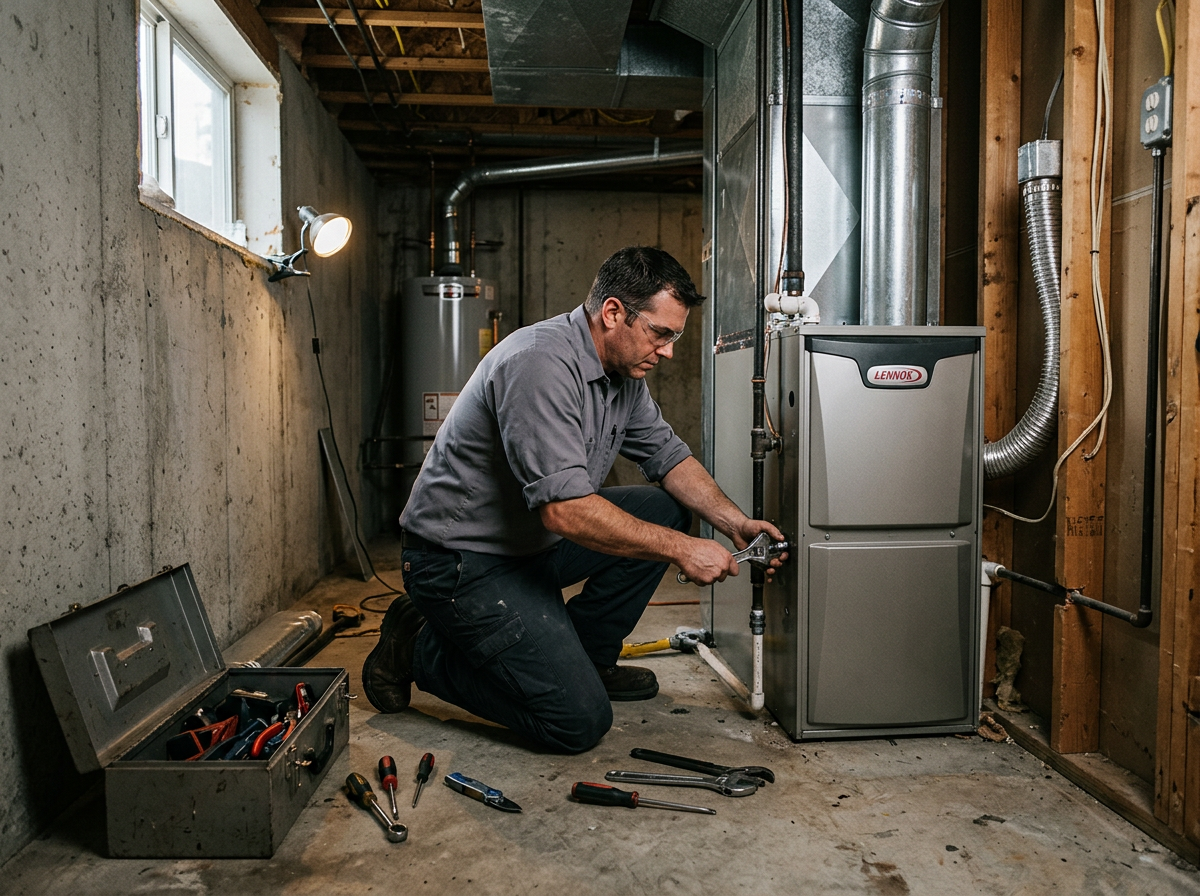
Accurate Manual J load calculations are essential in Boise because temperature inversions keep furnaces running at high output for days rather than short cycles. Oversizing leads to short cycling that fails to remove enough moisture from the dry winter air and accelerates wear on the heat exchanger. We measure actual heat loss room by room, factoring in the 35–40 °F daily swings common in shoulder seasons and the extra load created when cold air pools in the Treasure Valley basin.
Many North End and East End bungalows from the 1900s–1920s have retrofitted duct runs with high static pressure and limited mechanical-closet space. Newer tract homes in Meridian, Kuna, and Star often have builder-grade 80 % furnaces reaching end of life at the same time. We measure external static pressure before and after installation and resize or modify ducts so the new unit delivers rated airflow without straining the blower motor.
Venting and combustion-air requirements differ sharply between natural-gas homes and propane properties on the rural edges of Star, Middleton, and outer Kuna. Older tight closets frequently need dedicated combustion-air ducts or concentric venting to meet code. We verify existing vent sizing, slope, and termination clearances and install fresh-air intakes sized for the new appliance so the furnace operates safely under sustained inversion loads.
Every installation includes pulling the required city or county permit, performing combustion analysis at commissioning, and verifying that condensate drains and humidifier components are compatible with Boise's hard water. We set up the thermostat and test safety controls so the system runs reliably through the long inversion periods that define Treasure Valley winters.
Technician insight
In Boise the thing that catches most people out with furnace installation is the tight mechanical closets in North End bungalows; you can't just drop in a larger cabinet without reworking the venting and combustion air, or the new unit short-cycles during the first inversion.
North End Bungalow Furnace Replacement
A 1920s bungalow had an oversized 80 % furnace that short-cycled during inversions and left the house dusty. We performed a Manual J, found the ducts were undersized for the original load, and installed a properly sized 95 % unit with new return-air pathways and concentric venting. The system now runs longer cycles, maintains even temperatures, and meets current combustion-air code.
Furnace Installation Services We Offer
✓High-Efficiency Gas Furnace Installation
Replaces existing units with 95 %+ AFUE models sized for inversion duty and paired with proper venting in gas-served neighborhoods.
✓Propane Furnace Installation
Selects and installs propane-rated furnaces with correct orifices and regulators for rural Star, Middleton, and outer Kuna properties.
✓Ductwork Assessment and Modification
Measures static pressure and modifies undersized or leaky ducts common in North End bungalows before new furnace installation.
✓Combustion Air and Venting Upgrade
Adds dedicated combustion-air ducts or concentric vents required in tight mechanical closets of older Boise homes.
✓Manual J Load Calculation
Performs room-by-room heat-loss calculations that account for sustained winter loads instead of rule-of-thumb sizing.
Furnace Installation Cost in Boise, ID
| Service | Typical Range | What Affects It |
|---|---|---|
| Standard 80 % Gas Furnace Install | $3,200–$4,800 | Base price in homes with existing properly sized ducts and vents |
| 95 % High-Efficiency Gas Furnace Install | $4,600–$7,200 | Includes new PVC venting and condensate drain; higher in older homes needing combustion-air upgrades |
| Propane Furnace Install | $4,400–$6,900 | Adds regulator and orifice work typical on rural properties |
| Duct Modification Add-On | $800–$2,400 | Required when static pressure exceeds manufacturer limits in retrofitted bungalows |
Ranges are typical for Boise, ID and confirmed with an exact written quote before any work starts.
How it works
- 1
Site Assessment
We inspect the existing furnace, duct system, venting, and fuel type while noting home construction details that affect sizing.
- 2
Load Calculation And Equipment Selection
A Manual J calculation determines the correct capacity; we then match efficiency, fuel type, and venting requirements to the home.
- 3
Duct And Vent Preparation
Duct modifications or new venting runs are completed so the furnace can deliver rated airflow and safe combustion.
- 4
Installation And Commissioning
The new furnace is set, wired, and tested with combustion analysis; permits are filed and the system is turned over with operating instructions.
Pricing
Cost depends on efficiency rating, fuel type, and any duct or venting work required by the home's age and location.